

How to measure for your blinds
All you need is a steel tape measure and five minutes per window. Pick the fit, follow the three steps, then enter your width and height on the blind you like.
- Measure in millimetres, width first
- We make the allowance for an inside fit
- Outside fit is made to the exact size
Which fit do you need?
Measuring for an inside fit
For a blind that sits inside the window recess. Measure the recess and we make the allowance for the brackets, so the blind fits the gap.
 Step 1
Check the recess is deep enough
Measure the depth of the recess in the corner, where it's usually shallowest. Check it against the table below so the brackets and blind fit inside.
- Step 2
Look for anything in the way
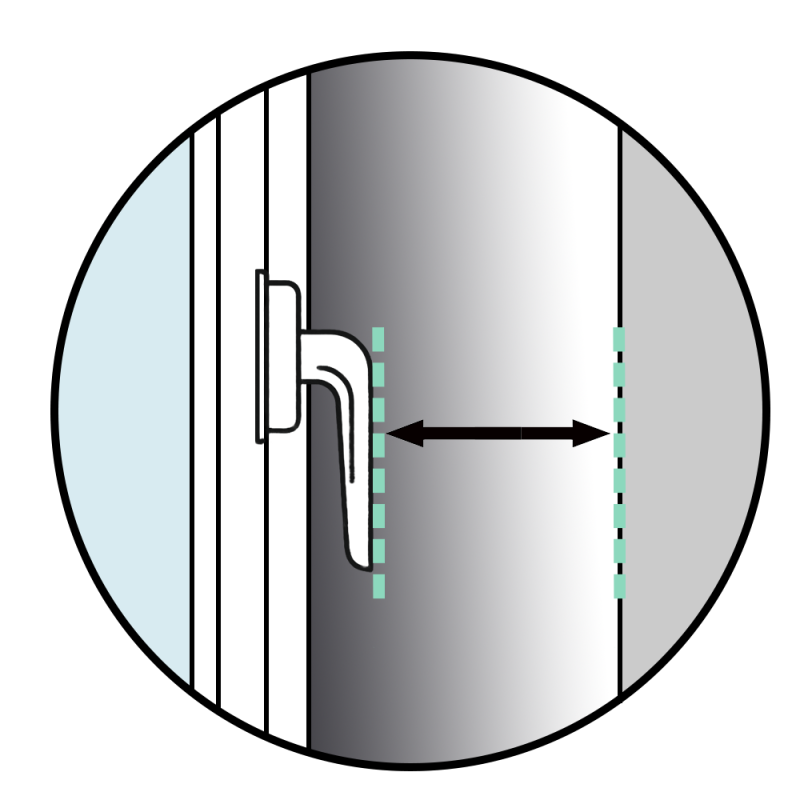
Handles, locks, stays and alarm sensors can stop a blind from rolling or hanging straight. Note how far they stick out, and check them against the depth you have.
- Step 3
Measure the width and height
Width: measure across the recess at the top, middle and bottom.
Height: measure at the left, centre and right.
Use the smallest width and the smallest height. That's the size you enter when you order, and we make the rest of the allowance.


Recess depth you need for an inside fit
| Blind | Minimum depth |
|---|---|
| Roller blinds | 55mm |
| Dual roller blinds (standard brackets) | 115mm |
| Dual roller blinds (slimline brackets) | 90mm |
| Wooden and PVC venetians | 65mm |
| 25mm aluminium venetians | 27mm |
| 50mm aluminium venetians | 57mm |
| Vertical blinds | 60mm |
| Honeycomb blinds | 55mm |
Dual rollers hang two blinds on one bracket, so they need more depth. Short on depth? The slimline dual bracket needs 90mm (it's 125mm high).
Measuring for an outside fit
For a blind fitted to the wall or frame above the window, overlapping the recess. Measure the size you want the blind to be. We make it to exactly that size, with no deductions.
- Step 1
Check below and around the window
Look for anything at the base or sides of the window, like a sill, handles or a heater, and allow for it in your height and width.
- Step 2
Measure the width
Measure the width you want to cover at the top, middle and bottom of the window, and add at least 65mm to the widest measurement so the blind overlaps the recess on both sides.
- Step 3
Measure the height
Measure from where the brackets will go, usually about 50mm above the frame, down to just below the sill or frame. That's your height.


Tricky windows
Wide windows and doors
For stacker doors and wide windows, one blind per section is usually best, so each section has its own blind and chain. Two blinds are also easier to handle than one very wide one. Blinds 1800mm wide or more ship as oversize.
Two blinds side by side
Measure each section as its own blind. For an inside fit across a window with a divider (mullion) in the middle, measure each side of the divider separately.
Shallow recess or a mullion in the way
With 27mm or more of depth, a 25mm aluminium venetian fits inside. With less than that, an outside-fit roller blind on the wall above the window is the answer, and it blocks more light too.
Handles and other obstacles
If a handle or lock sticks out further than the recess depth allows, choose an outside fit, or a front roll so the fabric rolls clear of it.
Keeping light out
An inside-fit blind always leaves a small gap at the sides, so a little light gets around the edges. If a dark room matters most, an outside fit with a back roll overlaps the frame and cuts down a lot of that edge light.
Left and right
Chain and cord sides are always as you look at the window from inside the room.
Millimetres, width first
Measure in millimetres and give the width first, then the height. Use a steel tape measure and keep it straight; width matters most.
Not sure about something?
Ask us a question and one of the team will get back to you, usually the same working day.
